
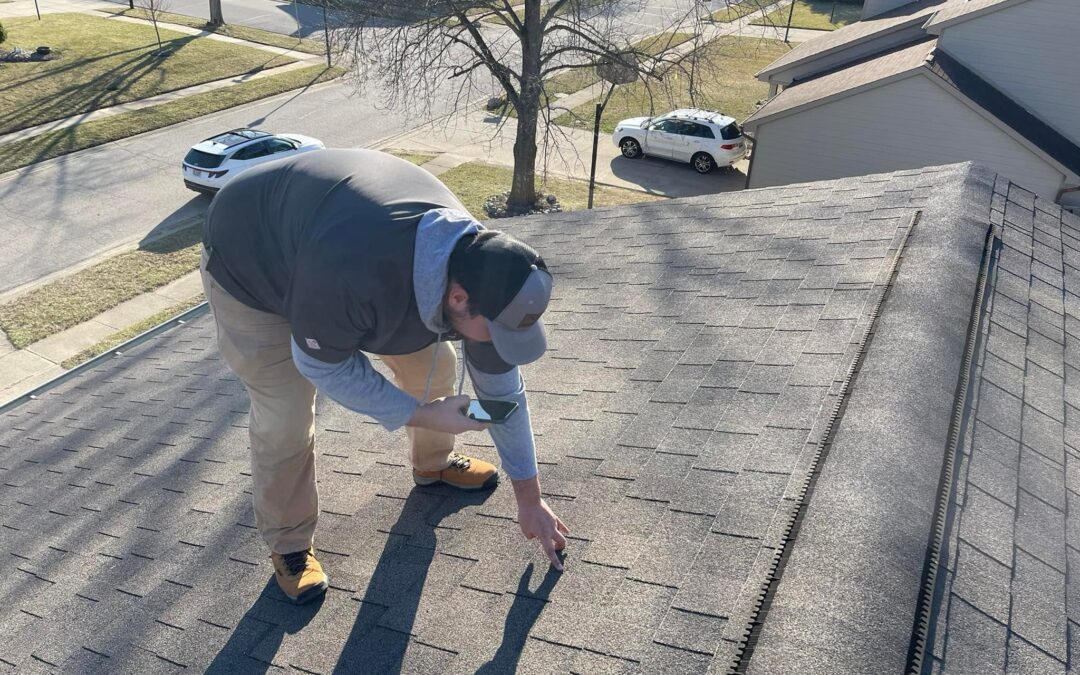
Indiana storms can move fast. A severe thunderstorm rolls through in the evening, hail hammers the neighborhood for ten minutes, and by morning everything looks calm — except you’re not sure what just happened to your roof. Here’s the frustrating reality about storm damage in Indianapolis: a roof that looks completely fine from the driveway can be significantly compromised. Hail bruises shingles, knocks out granules, and damages flashing in ways that aren’t visible from the ground.
The damage doesn’t show up as a leak right away — it shows up six months later when water starts finding its way in, and by then a straightforward insurance claim has gotten a lot more complicated. So here’s exactly what to do after a storm hits your roof in Indianapolis so you can get your roof repaired without paying more than you need to.
Table of Contents:
- Step 1: Stay Safe. Don’t Get on Your Roof.
- Step 2: Walk Around Your Home and Document Everything
- Step 3: Schedule a Professional Roof Inspection Before You File
- Step 4: File Your Insurance Claim Promptly
- Step 5: Have Your Contractor Present When the Adjuster Comes
- Step 6: Protect Your Home From Further Damage While You Wait
- Important: Watch Out for Storm Chasers in Indianapolis
- Why You Shouldn’t Wait To Call Someone
- Ultra Dry Roofing: Indianapolis’s No-Upsell Storm Damage Specialists
Step 1: Stay Safe. Don’t Get on Your Roof.
The impulse after a storm is to go check the damage yourself. Don’t do it.
A roof that’s just been through hail or high winds is wet, potentially weakened, and dangerous without proper equipment and training. You can learn a significant amount from the ground — and what you can’t learn from the ground, a professional inspector will handle.
Wait until the storm has fully passed and it’s safe to be outside before you do anything else.
Step 2: Walk Around Your Home and Document Everything
Once it’s safe, do a careful walk-around of your property and document anything that looks off — photos and video, taken as soon as possible.
What to look for outside:
- Missing shingles or shingle fragments on the ground
- Granules washing out of your gutters or downspouts — coarse, dark material that looks like sand is a clear sign your shingles took hits
- Dents on soft metal surfaces — gutters, downspouts, your AC unit housing. Fresh dents on these surfaces mean the hail was large enough to cause shingle damage
- Damaged or displaced flashing around the chimney or vents
- Debris on the roof from fallen branches or wind-carried material
What to check inside:
- New water stains on ceilings or walls
- Moisture or new damp smell in the attic
- Anything that wasn’t there before the storm
The photos and videos you take right now become the foundation of your insurance claim. The sooner they’re taken, the harder it is for an insurer to question whether the damage is new or pre-existing.
Step 3: Schedule a Professional Roof Inspection Before You File
Most Indianapolis homeowners instinctively call their insurance company first. There’s actually a better sequence: get a professional inspection done before you file, so you have a written damage report in hand when you make that call.
Here’s why this matters: a qualified roof inspector gets on the roof and identifies damage that no walk-around can find. Bruised shingles, compromised underlayment, soft spots in the decking, subtle impact marks across multiple panels — none of this shows up from the driveway. But all of it affects whether your roof is still protecting your home.
A written inspection report from a contractor who knows what to look for also gives you documentation that supports your claim — documentation created before an insurance adjuster has weighed in with their own estimate.
At Ultra Dry Roofing, our inspectors are not commission-based. Their only job is to tell you what’s actually going on with your roof — not to sell you the biggest project possible. If there’s no damage worth filing a claim over, we’ll tell you that too.
Step 4: File Your Insurance Claim Promptly
Indiana homeowners insurance typically covers sudden, accidental storm damage — hail, wind, falling trees. But most policies have filing windows, and waiting too long after a storm event can give your insurer grounds to question whether the damage is from that storm or from prior wear.
What to have ready when you file:
- Photos and video taken immediately after the storm
- The written inspection report from your contractor
- The date and time of the storm
- Documentation of any other property damage (vehicles, fencing, landscaping)
File as soon as your documentation is together.
A few things worth knowing about your policy:
Indiana policies often carry a separate, higher deductible specifically for wind and hail damage. Check what yours says before you file — it affects the math on whether filing makes sense for smaller damage.
And no matter what: a legitimate contractor will never offer to waive your deductible. That’s insurance fraud in Indiana, and the legal risk falls on the homeowner, not just the contractor. If anyone offers this, walk away.
Step 5: Have Your Contractor Present When the Adjuster Comes
This is the step most homeowners skip — and one of the most valuable.
Insurance adjusters work from their own estimates, and those estimates don’t always capture the full scope of storm damage — especially when hail damage is subtle, when there are multiple damage types across different areas of the roof, or when the adjuster is handling dozens of claims in the same neighborhood after a major storm.
A contractor who attends the adjuster visit can point out damage the adjuster might miss, provide additional documentation, and make sure the settlement reflects what the roof actually needs.
Ultra Dry Roofing meets with insurance adjusters on behalf of their customers as a standard part of the process — not as an add-on. Their goal is to make sure you get the best possible coverage, and having someone who knows roofing in the room during that inspection makes a real difference in how thoroughly the damage gets documented.
Step 6: Protect Your Home From Further Damage While You Wait
If your roof has an area where water is likely to get in before repairs are scheduled, temporary protection matters. Emergency tarping over the affected section prevents interior water damage from compounding during the time between inspection and installation.
Document any temporary protective measures with photos and keep receipts — most policies cover reasonable temporary repair costs as part of the claim.
Ultra Dry Roofing offers emergency tarping services for exactly this situation.
Important: Watch Out for Storm Chasers in Indianapolis
After any significant storm in the Indianapolis area, out-of-area contractors descend on affected neighborhoods with door-to-door pitches and deals that sound appealing in the moment.
The problem with storm chasers isn’t just their sales tactics — it’s what happens after the job. Many of them move on to the next storm-affected market before warranty issues arise. Their crews may not be properly licensed or supervised. And the installation quality on a rushed job, done by a crew that won’t be around next year, rarely holds up the same way a locally accountable team’s work does.
Before you agree to anything, ask how long the contractor has been operating in Indianapolis, request proof of licensing and insurance, and check their Google reviews from Indianapolis homeowners. A contractor worth hiring welcomes these questions.
Why You Shouldn’t Wait To Call Someone
If your roof doesn’t have an active leak, it’s easy to put the storm damage conversation off. Here’s why that’s a mistake:
A shingle that lost its granules to hail is no longer performing at full capacity. The UV exposure and weathering that those granules were blocking is now working directly on the asphalt beneath. It doesn’t fail immediately — it deteriorates quietly, month over month, until it does.
On the insurance side, the window to file a claim tied to a specific storm event doesn’t stay open indefinitely. The longer you wait, the harder it becomes to establish that your damage is from the storm you think it is rather than accumulated wear.
The earlier you get an inspection and make a decision, the more options you have.
Ultra Dry Roofing: Indianapolis’s No-Upsell Storm Damage Specialists
Ultra Dry Roofing was built by people who spent years watching other companies take advantage of homeowners — and decided to do something about it. Our No Upsell Guarantee means the price is the price, our inspectors aren’t commission-based, and our goal is simply to help you get the best possible roof without feeling nickel and dimed.
Storm damage claims are a significant part of what we do. We handle the inspection, the documentation, the adjuster meeting, and the installation — and we include GAF Timberline HDZ shingles with a 50-year warranty on every project at no extra cost.
For the full picture on roofing in Indianapolis — warning signs, repair vs. replacement, materials, and how to find a contractor you can trust — our complete Indianapolis roofing guide covers all of it.
Read the Indianapolis Homeowner’s Guide to Hiring a Roofing Contractor →
And when you’re in need of a fast inspection due to a recent storm, we’re one call away…
Schedule your free storm damage inspection with Ultra Dry Roofing →